
What Is an RCD Protective Switch — and Why It Could Save Your Life?
An RCD protective switch is the only device in your panel that protects you from electric shock. Learn how it works, how it differs from a fuse, and how to test it yourself in 10 seconds.
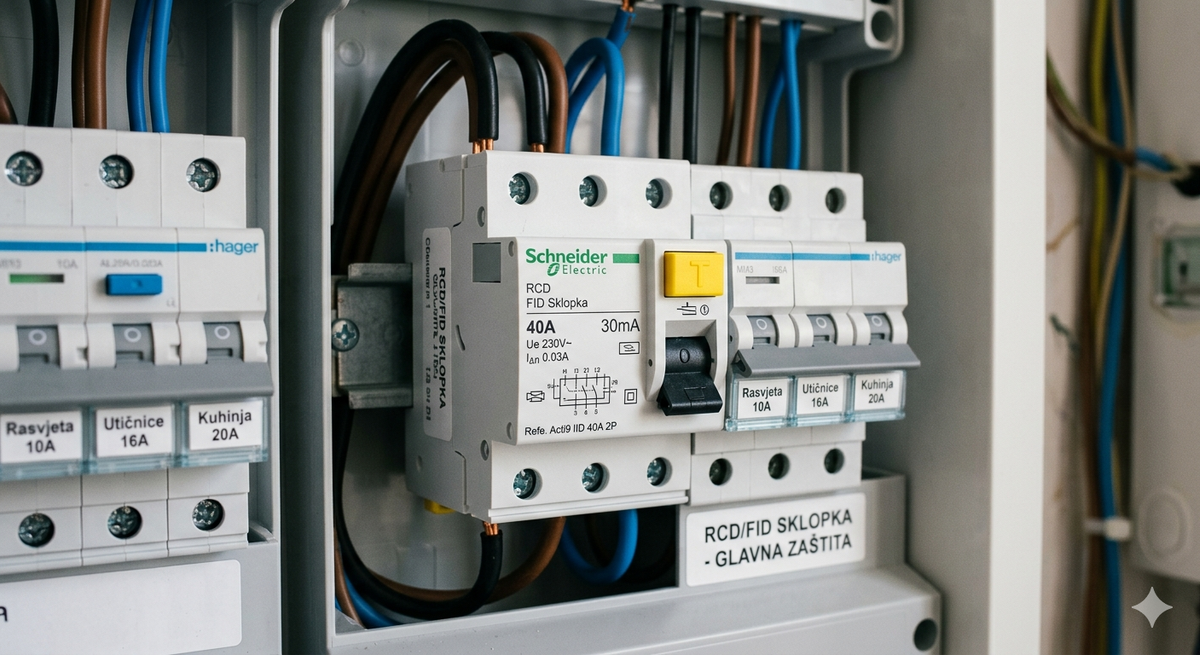
"And what's this wider switch with the T button?"
It's the question that greets me at almost every handover, as we stand in front of an open distribution board. The owner points at one component that looks different from all the others. The answer is short but important: that's the protective switch — the device that does the most important job in your home without you ever noticing it. At least while it's working.
What is an RCD protective switch?
A residual current device — in practice we call it an RCD, or an FID switch — is a device that constantly compares how much current flows into your installation with how much flows back out. In a healthy installation those two figures are equal. If some of the current "escapes" somewhere — through damaged insulation, a damp wall, or through a person who has touched a faulty appliance — the RCD detects it and cuts the power in a fraction of a second.
A standard household RCD reacts to a fault current of 30 mA (milliamps). That number isn't arbitrary: it's the threshold below which current through the body is not yet lethal. In other words, an RCD is the difference between an unpleasant "jolt" and cardiac arrest.
An RCD and an ordinary fuse are not the same thing
The most common misconception I hear on site is: "But I have fuses, so surely I'm protected." Unfortunately, not against this kind of danger.
- A circuit breaker (MCB) protects the cables and the installation from overload and short circuit — so the wire doesn't overheat and start a fire.
- A protective switch (RCD/FID) protects you — from electric shock.
These are two completely different jobs. A fuse will calmly "watch" current flow through your body, because from its point of view that's perfectly normal consumption. The RCD is the only component in the board that reacts to exactly that scenario.
How to spot the RCD in your own board
You don't have to be an electrician. Open the distribution board door and look for a component that:
- is wider than the ordinary breakers (it usually takes up two slots),
- has a button marked with the letter T (Test),
- most often sits first, right after the main switch.
If you can't find such a component anywhere and the house is older, there's a good chance there is no RCD at all. In installations built up to the early 2000s, sadly, that was not unusual.
Three things an RCD cannot do
To be honest — an RCD is not a magic wand, and it doesn't relieve you of every worry:
- It doesn't fix a bad installation. If the connections are loose and the cables undersized, the switch will either trip often or, worse, mask the problem until something more serious happens.
- It ages and "gets tired." The mechanism can stiffen over the years. A switch that hasn't tripped in five years isn't necessarily working — maybe it has simply never been tested.
- It doesn't help if it's wired incorrectly. We've seen boards where the RCD is neatly installed but bypassed by faulty wiring — so it sits there purely as decoration.
A test you can do yourself in 10 seconds
Manufacturers recommend testing the RCD every few months. Here's how:
- Press the T button on the switch.
- The switch must immediately snap to the off position and cut the power — the lights in the part of the home it covers will go out.
- Return it to the on position by hand.
If nothing happens when you press T, that's a serious sign: the switch is either faulty or wired incorrectly and needs to be checked by a professional without delay. This is exactly one of the warning signs we describe in How to Recognize Bad Electrical Installations.
The T button checks the mechanism — not the speed
An important and honest caveat: the T button only confirms that the mechanism works. It does not measure how fast the switch reacts, or whether the grounding is sound — and that's precisely what determines whether it will protect you in a real accident. That can only be established with an instrument, by measuring the trip time in milliseconds, which we do as part of installation testing and certification.
When to call a professional
Call an electrician without delay if:
- there is no protective switch in your board at all,
- the switch doesn't react when you press the T button,
- the switch trips for no obvious reason (that's most often a real fault it's protecting you from, not a nuisance to be bypassed),
- the house is older than 20 years and the installation has never been measured.
Installing or upgrading this protection is an integral part of every sound high-voltage electrical installation, and in Šibenik, Zadar and the surrounding area it's the cheapest life-insurance policy you'll ever pay for.
A good protective switch is one you never think about — because it does its job before you even realise something went wrong.
Planning a build or renovation, or simply not sure what's hiding in your board? Browse our services or contact us — we'll happily inspect your installation and measure whether the protection works the way it should.
Related Articles

What to Look for in an Electrical Subcontractor on Your Construction Project

Electrical Installation Regulations in Croatia — A 2026 Guide for Investors