How to Recognize Bad Electrical Installations? Tips for a Safer Home
Buying an apartment or moving into a renovated house is one of life's most exciting moments, but the true quality of a space often isn't visible at first glance. Learn how to recognize warning signs of bad electrical installations and protect your home.
Buying an apartment or moving into a renovated house is one of life's most exciting moments, but the true quality of a space often isn't visible at first glance. While wall colors and flooring quality are immediately noticeable, electrical installation work remains hidden deep within the walls. That's precisely why installation problems most often become apparent only weeks or months after moving in, when you start putting the system under everyday use.
As an engineer with years of experience working on residential buildings, I want to draw your attention to the key details that distinguish a reliable installation from one that could cause you headaches. The goal of this article is education — so you know how to recognize the signals your home is sending you.
Warning Signs in Everyday Use
Although wires are invisible, poor electrical installations almost always send signals. Here's what you should pay attention to:
Warm Outlets
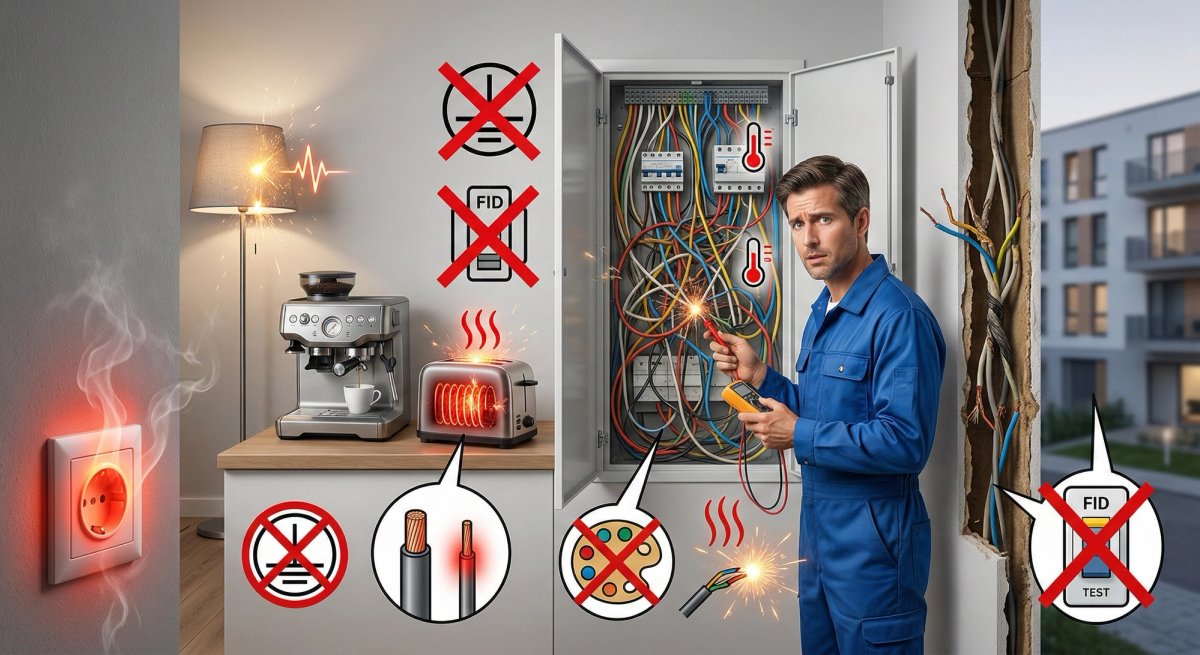
Outlets and switches should never be warm. If you feel heat, crackling, or smell burnt plastic, it's a sign of poor contact. A loose connection creates high resistance, which can lead to sparking and fire hazards.
Frequent Circuit Breaker Trips
If a breaker trips every time the washing machine and kettle run simultaneously, the system is likely poorly designed. This indicates circuit overload or an illogical distribution of appliances.
Flickering Lights
If lights flicker slightly when the refrigerator or air conditioner kicks in, it may mean that cables with insufficient cross-section (thickness) have been installed in the walls, or that connections in junction boxes have weakened.
The Distribution Panel — A Mirror of Installation Quality
Even without technical knowledge, a look at the distribution panel (the box with circuit breakers) can tell you a lot about the quality of electrical installations throughout the building.
Wire Tidiness
Open the panel. If the wires are neatly arranged and organized, it's a sign of a meticulous electrician. A "nest" of tangled wires often hides rushed work, increasing the risk of errors during future repairs.
Clear Labels
Every breaker must have a legible label (e.g., "Kitchen", "Boiler", "Living Room Lights"). Without labels, navigating an emergency becomes an impossible task.
RCD (Residual Current Device)
In a modern panel, an RCD (the wider device with a "Test" button) is essential. It's crucial for your safety because it cuts power in a fraction of a second in case of a device fault, preventing electric shock.
Aesthetics vs. Safety
In practice, it's important to distinguish between two types of defects. Aesthetic defects, such as a slightly tilted switch, spoil the visual impression but aren't dangerous. On the other hand, safety issues are those that aren't immediately visible.
The most common mistake we see in the field is loose connections. An electrician in a hurry may forget to tighten a screw in an outlet sufficiently. That outlet will work for months, but as soon as you plug in a powerful heater, the connection will start heating up dangerously. Quality electrical work is recognized by the fact that all contacts are firm and cables are adequately protected.
Why Are Measurements Important?
As a user, you can notice flickering or warmth, but there are things that even the most experienced eye cannot detect. These are parameters that can only be determined with professional measuring instruments:
Grounding Integrity
The only way to be sure that excess voltage will go into the ground, and not through you.
Protection Trip Time
Checking whether your RCD reacts fast enough (in milliseconds).
Insulation Condition
Checking for current "leakage" within the walls.
Final Advice: Safety Has No Compromises
Electrical installation problems don't resolve themselves. If you notice any of the mentioned signs, the most important thing is not to ignore them. Education is the first step — knowing what to look for means taking control of your home's safety.
A quality installation isn't just one that works, but one that protects you and that you don't have to think about for the next 30 years. If you have any doubts about your system's integrity, seek expert advice and have the necessary measurements taken. Peace of mind in your own home is priceless.