When Do You Actually Need an Electrical Installation Certificate?
Many people only think about electrical certification when the move-in process hits a wall. Learn when it's mandatory, who can issue it, and what this document actually guarantees.

Many people only think about electrical certification when someone puts a "stop" on their move-in process. In practice, there are several key situations where this document is indispensable:
1. Technical Review and Occupancy Permit
Without a valid inspection report, you cannot pass the technical review of electrical installations. The commission requires black-and-white proof that everything was built according to the project and that safety parameters (such as protection trip speed) are within permissible limits.
2. Grid Connection (Utility Company)
If you're building a new house or increasing your contracted power, the utility company will require proof of installation safety before they install your meter and energize the system. For them, it's assurance that your installation won't cause problems on their grid.
3. Property Sales and Insurance
An increasing number of informed buyers request an electrical installation certificate before paying hundreds of thousands of euros for a property. Additionally, in case of a fire caused by electricity, insurance companies first check whether you have a valid inspection report. If you don't, damage compensation often becomes questionable.
4. Commercial Space Leasing
Every restaurant, shop, or office must have a periodically renewed certificate (usually every 1 to 4 years, depending on the industry) to meet minimum technical requirements and occupational safety regulations.
What Does the Certification Process Look Like in Practice?
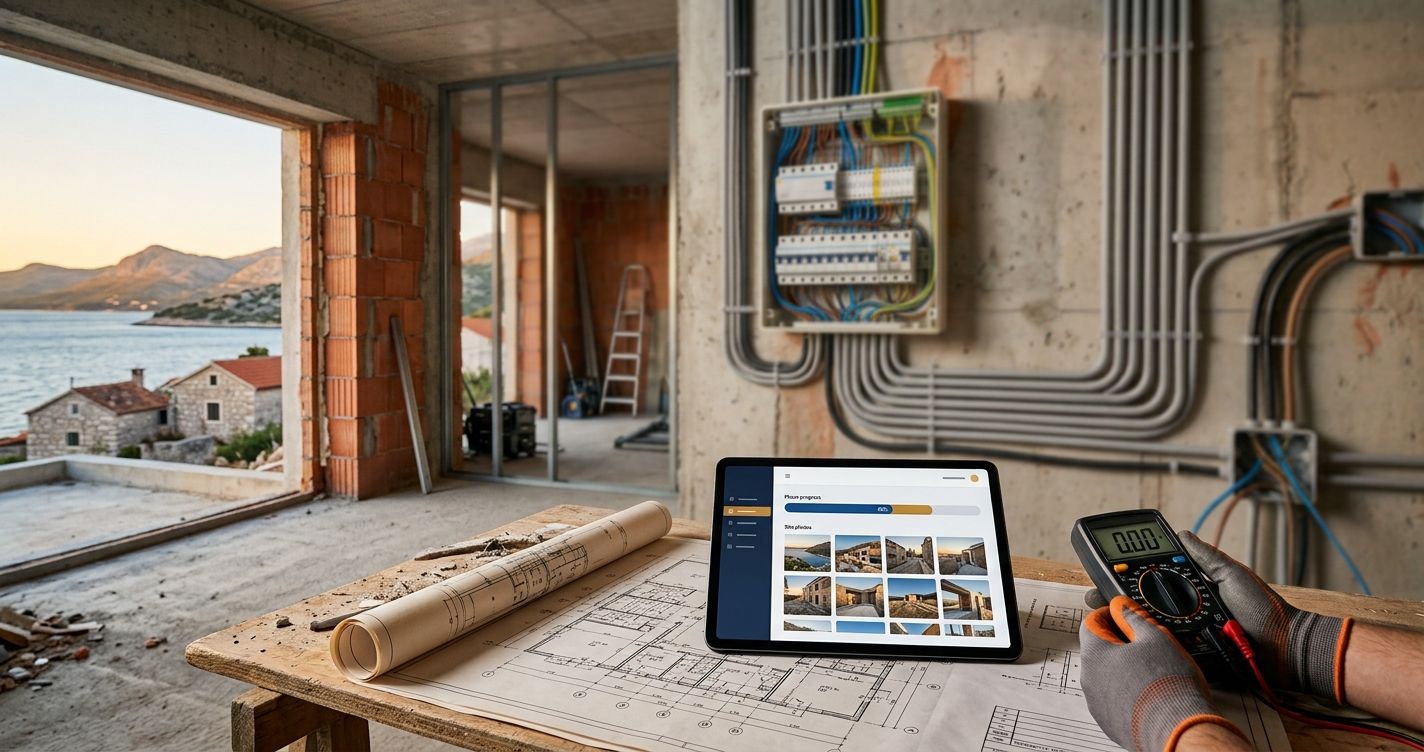
The process isn't just "walking around with a folder." When I arrive at a property, commissioning and testing electrical installations follows a strict procedure consisting of three phases:
Visual Inspection
First, I check what's visible to the naked eye: whether outlets are firmly installed, whether breakers are the appropriate rating for the wire cross-sections they protect, and whether the distribution panel is neatly connected and labeled.
Electrical Measurements (Instrumental Phase)
This is where we use specialized measuring devices (such as Metrel or similar professional instruments). We measure:
Insulation resistance: We check whether cables are damaged inside the walls.
Grounding continuity: Whether every outlet and metal part (e.g., water heater) is truly connected to ground.
RCD trip time: We simulate a fault to see if the device will cut power fast enough to save a life in case of shock.
Who Can Issue a Certificate and Why Not Every Paper Is the Same?
This is where users most often make mistakes. An electrical installation certificate is not issued by your neighbor who "knows electricity," nor by every electrician who pulled your cables.
The inspection report must be issued by an authorized person (a certified engineer or a company registered for testing) who possesses:
Appropriate licenses and authorizations.
Regularly calibrated measuring instruments.
I often receive inquiries: "I just need the paper, everything works." My answer is always the same: That paper is my criminal liability, but also your safety. If someone issues a report "sight unseen," they risk your life and their license.
Typical Problems We "Catch" During Testing
Through years of work, I've learned that an installation that "works" doesn't necessarily mean it's safe. Here's what we most commonly discover during electrical measurements:
Faulty RCD: The device sits in the panel but doesn't respond to testing at all. It's like driving a car without brakes – as long as everything's fine, you don't notice the problem, but in a critical moment, the system fails.
No grounding in outlets: Often during renovations of old apartments, tradespeople pull new wires but forget to check whether the main grounding supply is even functional.
Phase and ground swap: An extremely dangerous mistake where the metal casing of an appliance (e.g., a stove) can become energized.
What Does the Electrical Installation Inspection Report Contain and How Long Is It Valid?
After the work is completed, you receive an Electrical Installation Inspection Report. This is a multi-page document that contains:
Property and investor data.
A list of all measurements and obtained values (it must be evident they're within standards).
A final assessment: "Satisfactory" or "Unsatisfactory."
Signature and stamp of the authorized person.
For residential buildings and family homes, the recommendation is to repeat testing every 10 years, while for public spaces and industry, this interval is significantly shorter.
Conclusion: Certification Is Not a Formality, But a Confirmation of Peace of Mind
When you pay for an electrical installation certificate, you haven't paid for a piece of paper. You've paid for a professional who, with their knowledge and expensive equipment, guaranteed that your child won't get shocked by the metal casing of a washing machine, or that a loose connection in the wall won't cause a fire while you sleep.
Quality electrical installation work only ends when it has been tested and documented. If you've just finished a renovation or construction, don't skip this step. It's the only moment when you can be 100% sure of what's behind your walls.