
Electrical Installation Regulations in Croatia — A 2026 Guide for Investors
What every property investor must know about electrical installations under current Croatian regulations. Legal obligations, safety requirements, common mistakes, and practical tips from an expert on the ground — a complete 2026 guide.
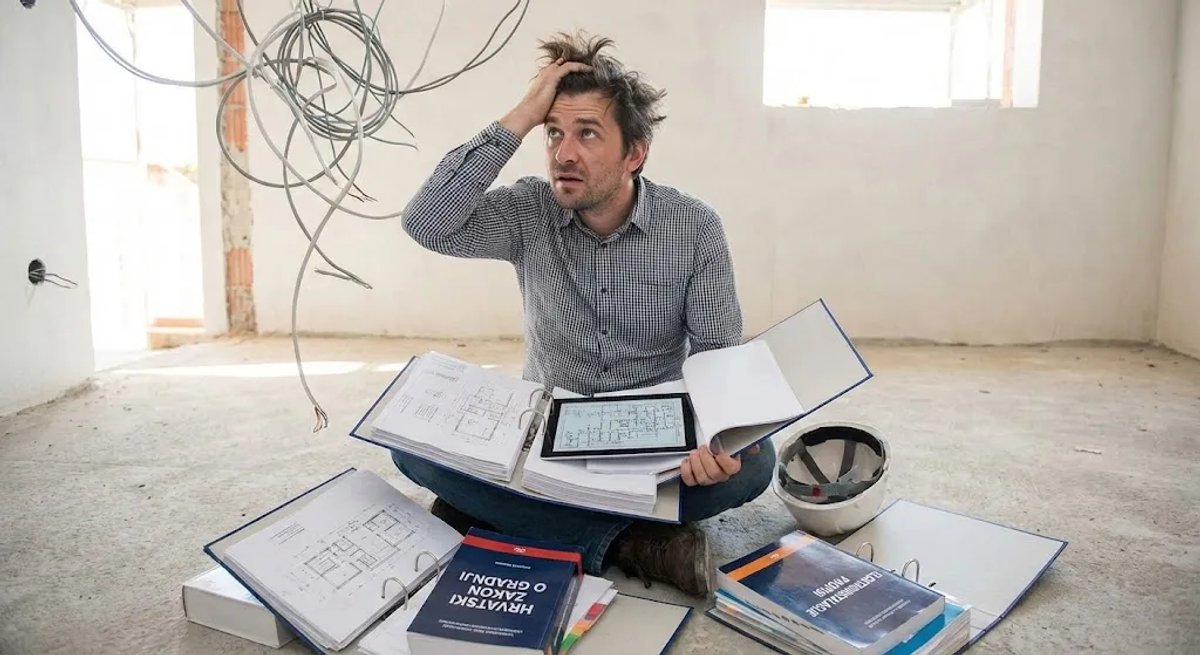
When embarking on building a family home, an investor's attention naturally gravitates toward the visible — the room layout, the facade colour, and the perfect ceramic tiles. However, as an electrical engineer and licensed contractor who supervises work on-site every day and attends technical inspections across Croatia, I have to share one undeniable truth. Your house is, above all, a machine. In that machine, electricity is not merely a matter of comfort — it is the primary safety system.
While it may be tempting to plan sockets and switches on the fly with workers, under the law you, as the investor, bear sole responsibility for the safety and legality of that system. A poorly glued tile will annoy you visually, but substandard wiring can cost you your property — or, in the worst case, your life. In this article I'll explain, without dry recitation of legal clauses, what electrical installation work entails, what your actual obligations are, and how to avoid dangerous pitfalls on a construction site.
Core Obligations of the Investor: From Design to Occupancy Permit
On construction sites I very often hear the phrase: "Just add three more sockets over there, we don't need a project for that, we'll work it out." Your obligations as an investor are clearly defined by the Construction Act through three unavoidable steps:
1. Main Electrical Engineering Design
Everything starts with a quality design. This is not just a formal document for obtaining a building permit — it is a precise technical safety plan. The designer calculates loads for a heat pump, induction hob, and EV charger, and based on those calculations determines cable cross-sections and the type of protective devices. If you decide mid-construction to install a powerful sauna in the basement without informing the designer, the existing plan cannot accommodate it and you directly risk dangerous overloading of the entire system.
2. Proper Execution and Documentation
All contracted works must be carried out exactly according to that design. This is where a critical moment arises. The contractor you engage must be licensed and registered for this type of work. Why? Because upon completion they must issue a Contractor's Statement of Completed Works. With this document, they legally guarantee before inspectors and the law that all installed materials are certified and that the installation was executed strictly according to professional standards.
3. Final Testing and Technical Inspection
Once the sockets are on the wall, the job is not over. Before an occupancy permit is issued, an independent licensed tester must use calibrated instruments to thoroughly measure the entire installation. If all insulation resistance measurements and protection-device response times are within prescribed limits, they issue a Report on Electrical Installation Testing. For your electrical installations to pass the technical inspection according to regulations, that report must be flawless. Without it, the supervising engineer cannot sign the final report, and the occupancy permit remains out of reach.
Key Safety Requirements for a Family Home's Electrical Installation
When it comes to the technical parameters mandated by the 2026 electrical installation regulations, the standards are strict for good reason. Technology advances, household energy loads grow, and a family home's electrical installation must now meet the following without compromise:
Proper Earthing and Equipotential Bonding
Earthing is your first shield against electric shock. It consists of a galvanised or stainless-steel strip that is laid directly into the foundation reinforcement before concrete is poured, serving as the foundation earth electrode. Its job is to safely conduct any "stray" voltage to the ground in the event of an appliance fault. It frequently happens that, in the rush of construction, the strip is forgotten while excavators are still on site. Driving earth rods into the yard afterwards is significantly more expensive and technically inferior. Additionally, all large metal parts in the house (water and gas pipes, solar panel mounts) must be connected to the equipotential bonding system so you don't get an electric shock while taking a shower.
RCD (Residual Current Device): Your Best Friend in the Distribution Board
This differential-current device in the distribution board literally saves lives. Its task is to detect whether current is "leaking" outside the installation — for example, through a damaged drill cable or through a human body. If it detects an irregularity, it cuts the supply in a fraction of a second. I often see attempts on site to hang an entire house off a single RCD to save money and space in the board. Imagine an outdoor terrace socket getting slightly damp from rain and tripping that one main device — the entire house goes dark, and your freezer defrosts while you're at work. A properly designed system has multiple, strictly separated RCDs, with a sensitivity of 30 mA specifically for bathrooms.
Adequate Conductor Cross-Sections and Separate Circuits
Every copper cable has its endurance limit. High-power appliances must have their own dedicated circuit — a separate cable running directly from the distribution board to that appliance. If an undersized cable (inadequate cross-section) is used for a powerful oven, it will heat up significantly under load. In the best case breakers will trip constantly; in the worst case the insulation melts behind the plaster and a fire breaks out.
Properly Installed Lightning Protection
Many people assume that a lightning-protection system is not mandatory for a family home, but the need for one is determined by a risk assessment within the main project. If the calculation shows that the risk for your location exceeds the permissible threshold, a lightning-protection system becomes a strict legal requirement. It captures the strike on the roof and safely conducts it to the foundation earth electrode, protecting the structure from mechanical damage and fire, while surge-protection modules inside the board protect your sensitive electronics from being completely destroyed.
Most Common Investor Mistakes: Savings That Can Cost You Dearly
In my experience, investors rarely make mistakes out of bad intentions; it usually comes down to a lack of information or trying to cut the budget in exactly the wrong places.
- "Under-the-table handyman" instead of a licensed company: Construction budgets routinely exceed their limits, so it's tempting to hire someone who'll work cash-in-hand for a lower daily rate. But who will sign the paperwork for the technical inspection at the end? The initial saving regularly turns into a nightmare of paying a legitimate engineering firm to subsequently survey the situation, test someone else's work, and assume legal responsibility for it.
- Ad-hoc changes on site: You move the kitchen island, add a whirlpool bath, or install powerful heaters on the terrace — and the project doesn't reflect any of it. Every such improvisation creates chaos in the distribution board and can lead to dangerous phase overloading at the main connection. All modifications must be recorded and approved through an As-Built Design.
- Skimping on empty conduits: Investors often think only about what they have today. Running an empty corrugated conduit from the board to the yard for a future EV charger costs a few euros during the rough-build phase. If that conduit isn't there, in five years you'll be paying hundreds of euros to dig up the yard and break through the finished, freshly installed facade.
A Practical Expert Tip From the Construction Site
A safe house starts with a good design and a reliable, qualified contractor. Treat electricity as a long-term investment in your family's safety, not as a cost to be slashed at all costs.
As a field expert, here is one extremely practical tip: Before the plasterers and floor layers start rendering the walls and pouring screeds, take out your phone and record a detailed, slow walk-through video of every room. Precisely film where cables run, where junction boxes are, and where conduits sit in the floor. Save that footage somewhere safe, in the Cloud. A few years from now, when you want to drill a hole in the wall for a new shelf, picture frame, or TV mount, that video will literally save your life by preventing you from accidentally drilling through a live main power cable.
Planning a build or renovation? Don't compromise on electrical installations. Contact us for expert advice and a quote that puts quality and safety first.
Official Sources and Applicable Regulations in Croatia (As of 2026)
All claims, standards, and obligations cited in this article are based on the currently applicable legislation of the Republic of Croatia.
- Construction Act – The overarching law defining the obligation to produce a design, the roles of the supervising engineer and contractor, and the technical inspection procedure. A completely new Act was adopted at the end of 2025, effective from 2026 (Official Gazette 155/25).
- Technical Regulation for Low-Voltage Electrical Installations (OG 5/10) – The fundamental by-law prescribing technical properties, shock protection, RCDs, cable routing, and testing requirements.
- Technical Regulation for Lightning Protection Systems on Buildings (OG 87/08, 33/10) – Defines how to prepare a lightning-strike risk assessment and the professional rules for proper earthing and lightning-protection installation.
- Primary regulation (OG 87/08) and amendments (OG 33/10)
- Ordinance on Technical Inspection of Buildings (OG 46/18, 98/19) – Prescribes the exact procedure for technical inspections and all mandatory documentation (such as Contractor's Statement and Test Report) required by the committee for issuing an occupancy permit.
Related Articles
What to Look for in an Electrical Subcontractor on Your Construction Project
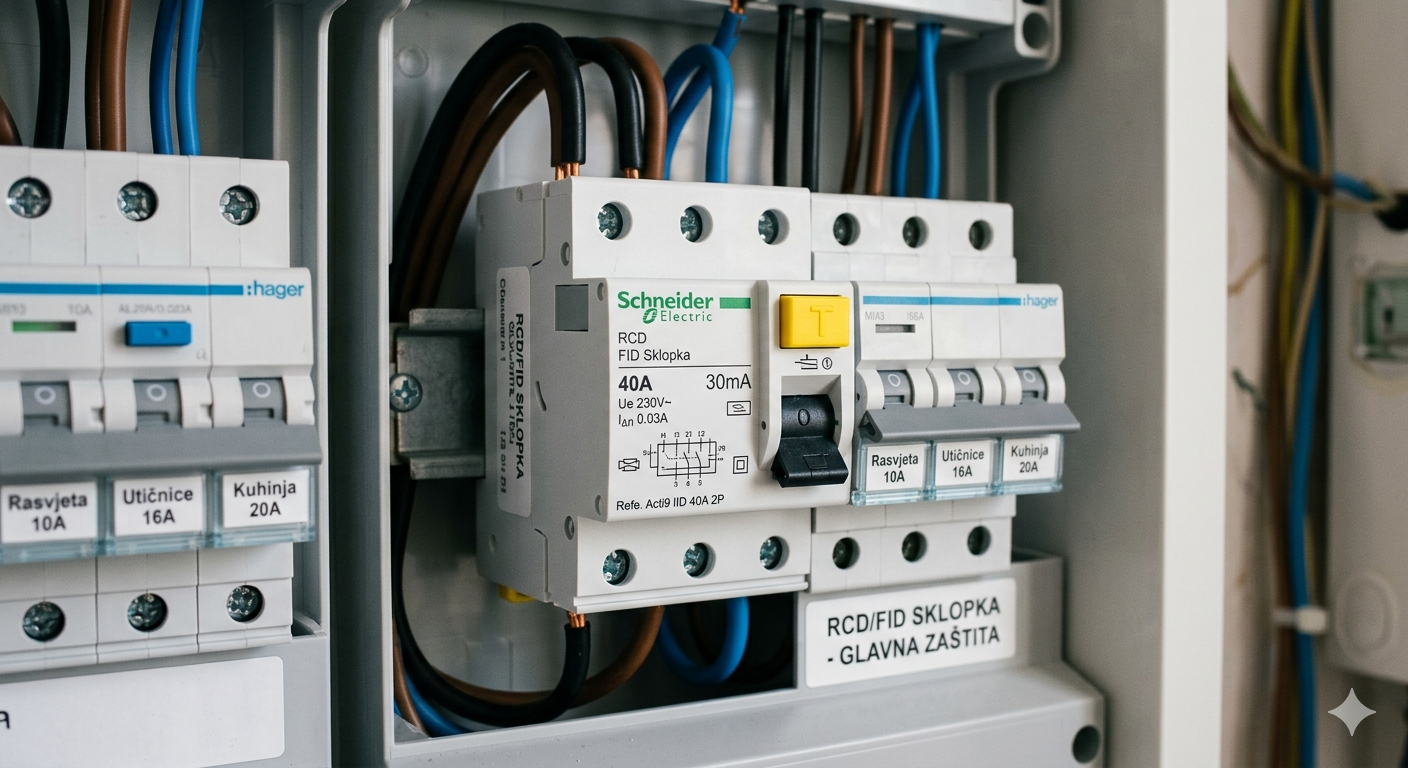
What Is an RCD Protective Switch — and Why It Could Save Your Life?
How Long Do Electrical Installation Works Take — A Real Family Home Project Timeline
Industry Technology Leaders
We exclusively use equipment from the world's leading manufacturers of electrical systems and smart technology.