Questions to Ask Your Electrician Before Signing a Contract
Six questions that reveal a serious electrician before you sign: references, an itemized quote, progress tracking, the safety certificate, and fair payment terms.

"How do I know I'll get an honest job?" That's the question I hear at almost every first meeting — usually while we're standing in an empty house with bare walls and a stack of quotes from different contractors on the table. The owner is looking at three sheets of paper, three different numbers, and not one of them actually says what they're getting.
Electrical work is hidden work — once the cables go into the wall and under the plaster, you can't see how the job was done anymore. So quality isn't chosen by looking at finished work; it's chosen by listening to the answers before the work starts. Here are the questions that tell you fastest who you're dealing with.
1. Do you have references, and can I call a past client?
A serious contractor has finished projects and no problem showing them. Ask specifically: where they worked, what kind of house or apartment, and whether it's fine to call the owner. A good tradesman hands over a contact without hesitation — a bad one finds a reason why right now isn't a good time.
References also tell you something subtler: whether the contractor actually does what you need. Someone who only does new builds isn't necessarily the right choice for converting an old stone house, and the other way around.
2. What exactly is in the quote — line by line?
This is the most important question, and the one most cheap quotes fail. Ask for an itemized quote — a list of all work and materials with quantities and prices, not a single round number at the bottom of the page.
An honest quote clearly shows:
- the number and type of circuits (outlets, lighting, high-load appliances like the cooker and AC)
- the cable type and cross-section, plus the type of distribution board and breakers
- whether wall chasing, conduit laying, and post-work cleanup are included
- what is not included (e.g. the final wall finishing after chasing)
Once it's all written down, you can finally compare two quotes fairly. The lowest number that hides half the job almost always turns out to be the most expensive in the end. We covered this in detail in How to Recognize Bad Electrical Installations.
3. How will I track progress and changes during the work?
Something always changes on site — you move an outlet, add a circuit for the water heater, decide on ceiling lighting. Ask how the contractor records that. If everything is agreed "on a handshake," you end up with disputes over the price at the end.
We log every change digitally, so at any moment you know what was agreed, what was done, and how it affects the final bill. No surprises on the last invoice.
4. Who guarantees the installation is correct and safe?
When the work is finished, a serious contractor issues a Statement of Performed Work — a document certifying the installation was carried out according to the project and regulations. Without it, you can't get an occupancy permit for the building.
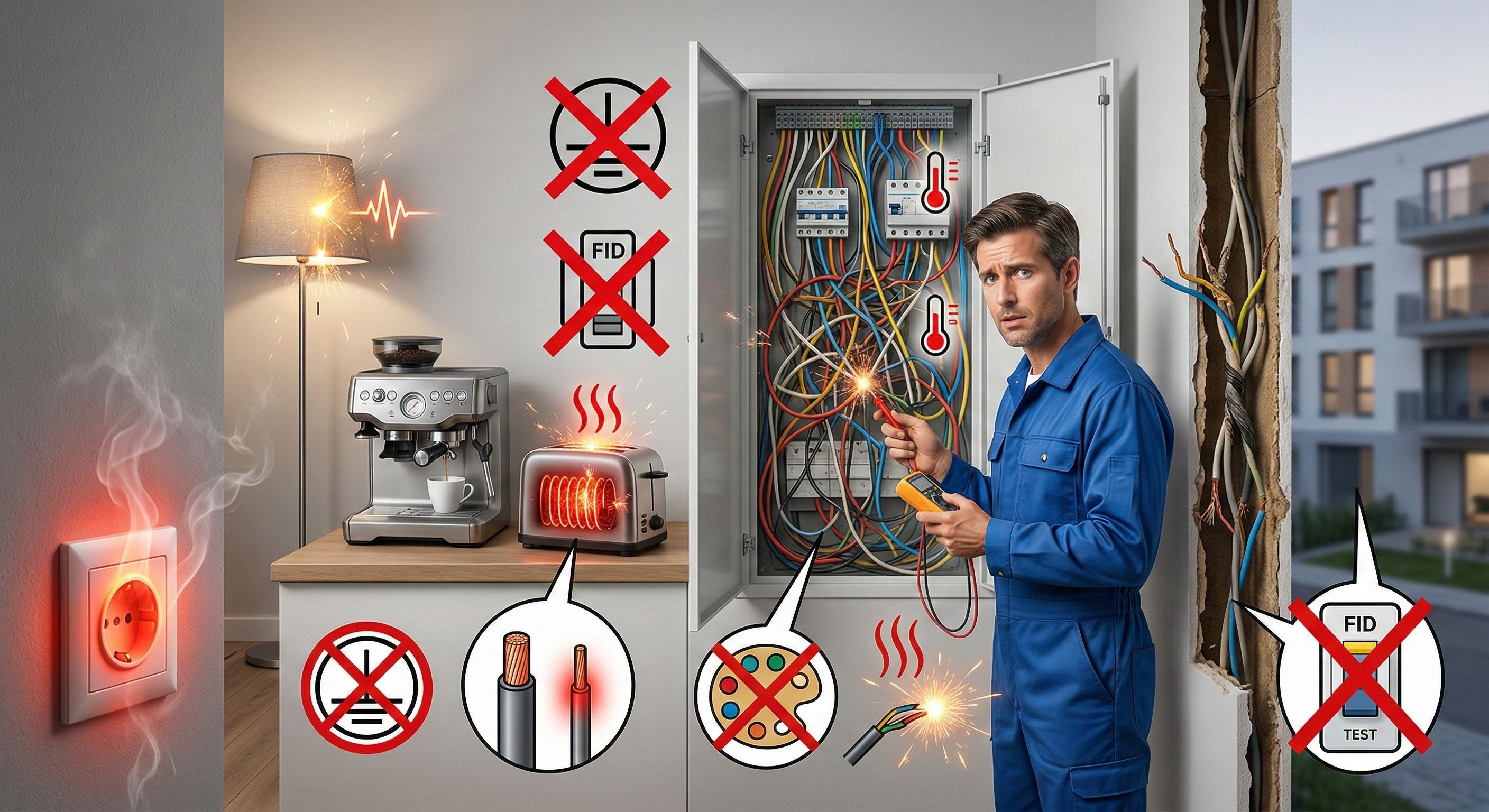
Also ask about the certificate (atest) — testing and measurement of the installation (earth resistance, correct operation of the protective switch, continuity of the protective conductor) that confirms on paper everything is safe. In particular, check whether an RCD (a residual current device that cuts power in a fraction of a second when it detects leakage) is installed, preventing electric shock. If a contractor shrugs at the word "certificate," that alone is reason to walk away. We do this as a standalone service: testing and certification.
5. How and when do I pay?
A fair payment schedule is tied to work done, not to the calendar. Typically a small advance for materials, then payment by phase (e.g. after rough work, then after finishing), and the balance at the end once everything is tested and handed over. Steer clear of a contractor who wants a large share up front, before anything is built.
All of it belongs in the contract — price, schedule, deadline, and warranty. A verbal agreement is not a contract.
6. Who will actually be on site?
Sometimes one person gives the quote and a completely different crew does the work. Ask who runs the job, how many people show up, and who your contact is when something gets stuck. We're the first on site and the last to leave — from the first conduit in the wall to handing over the keys.
What good answers sound like
You'll notice a pattern: to every one of these questions, a good contractor answers calmly, concretely, and without dodging. References given, quote broken down, changes logged, certificate issued, payment tied to work. These aren't tricks — it's simply what a job done properly looks like.
Planning a build or a renovation? Browse our high-voltage installation services or get in touch — we'll review your project and help the electrical work run without surprises. The assessment is free.