Do I Need to Replace My Electrical Installations? A Guide to Making a Safe Decision
If you live in an older house or apartment, you've probably wondered whether the wires in your walls are still safe. Learn what to look for and when electrical replacement is truly necessary.
If you live in an older house or apartment in Croatia, you've probably looked at your outlets at least once and wondered: "Are these wires in the walls still safe, or do I need to replace them immediately?"
This is one of the most common questions we receive. The reason is perfectly clear — no one wants to spend weeks inhaling dust, breaking walls, and dealing with unexpected costs if it's truly not necessary. On the other hand, the fear of fire or electric shock drives us to be cautious.
The answer to this question is rarely a simple "yes" or "no." As engineers with years of experience, in this article we'll calmly and without overcomplicating things explain what you should pay attention to in order to make the best and safest decision for your home — without having to call anyone to "dig" around your house for an inspection.
Age of Installations Alone Is Not the Only Criterion
When we think about electricity, the first thought is often the year the building was constructed. Although materials age over time, it's important to know that age alone is not the only measure of safety.
In practice, we frequently encounter old electrical installations from the seventies or eighties that were originally executed superbly, meticulously, and with exceptionally high-quality materials. If such installations haven't been tampered with by unqualified hands over the years and haven't been daily overloaded, they can still function perfectly well today. On the other hand, there are significantly newer installations that have already become risky because they were done hastily from the start or have been damaged over time by poor modifications.
The main difference between an old but safe installation and one that has become dangerous lies in the way it was executed, the load it bears daily, and its current technical condition.
The Clash of Modern Habits and "Old" Wires
To understand why old installations often "struggle" today, we need to look at how we live now. When houses were built 40 years ago, the average household had one television, a refrigerator, a water heater, and a few light bulbs. The system was perfectly designed for such relatively low consumption.
Today, in that same house, air conditioners, induction cooktops, washing machines and dryers, and microwave ovens are all running. Old installations simply weren't designed for such a quantity and power of modern devices. Wires often have a smaller cross-section (thinner), and modern safety standards didn't even exist back then. When you load such an old system with today's habits, electrical installation safety is seriously called into question.
Clear Signs That Electrical Replacement Is Necessary
Your home will often signal you when things are no longer working properly. These are the most common signs from our practice that indicate electrical replacement is truly needed — and ones you can spot yourself:
Worn Conductors and Brittle Insulation
The plastic or rubber insulation that protects copper has a finite lifespan. Due to years of use and constant heating, this insulation becomes brittle and peels at the slightest touch (especially visible in junction boxes and at light fixtures). When wires are left exposed, the risk of short circuits rises dramatically.
Lack of Protective Conductor (Grounding)
In many old buildings, a system with only two wires (live and neutral) was used, without the third, yellow-green wire that serves as grounding. Grounding is your main shield against electric shock. The absence of this conductor today represents a serious risk.
Frequent Breaker Trips
If your breakers "trip" as soon as you turn on the oven and vacuum cleaner at the same time, it's a defensive sign that the installation cannot handle the load. Regular overloading severely heats cables and permanently damages them over time.
Warm Outlets and Switches
Outlets and switches should never be warm to the touch! Heat, black marks, or the smell of burnt plastic are classic signs of dangerously poor contacts inside the wall.
Improvised Extensions
The biggest problem with old houses is decades of amateur repairs. Extension cords walled into walls or connecting wires with electrical tape are "DIY" solutions that are extremely unsafe.
Does Everything Need to Be Replaced Immediately, or Is There an Alternative?
The good news is that a complete replacement of all wires in the house is not always immediately necessary. In certain situations, electrical installation work can be planned gradually.
If the cables in the walls are still in good condition, the safety level can be dramatically raised by replacing the old distribution panel with a modern cabinet equipped with automatic breakers and mandatory installation of an RCD (residual current device).
Additionally, installations can be replaced selectively, room by room (e.g., kitchen and bathroom first, where the biggest consumers are), while lighting in bedrooms can wait for the second phase of renovation.
What Are Your Next Steps?
The decision to renovate your electrical installations is not something that should be made in panic, but you absolutely must not ignore warning signs.
As a small company focused on expert consulting, our goal is to help you make the right decision without unnecessary site visits and costs. We believe that the vast majority of problems can be diagnosed based on your accurate information and a visual inspection of key areas (such as the distribution panel).
Here's what you can do right now:
Calmly and visually inspect your home according to the points listed above.
Photograph your distribution panel (the box with breakers).
Write down the symptoms you notice (e.g., "the light flickers when I turn on the AC", "the kitchen outlet is warm").
Electricity doesn't forgive guesswork. If you live in an older property and suspect your installation is worn or faulty, the most important thing is not to make decisions on your own. The signs we've listed serve as a guide, but the only true confirmation is a professional inspection and testing by authorized persons.
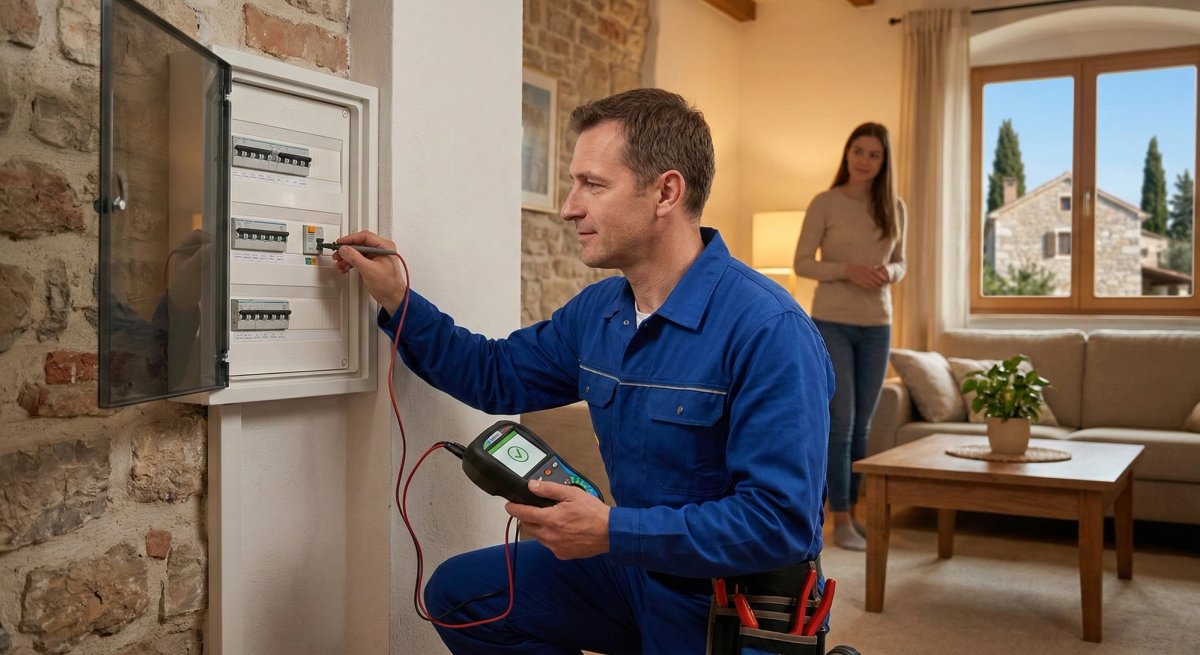
Our practical advice is to engage a professional who will use professional measuring instruments to check insulation condition and protection integrity. Timely detection of problems often means you'll get by with minimal interventions instead of a major reconstruction. Your home must be a safe place — ensure it by leaving safety to the professionals, not to chance.